
Brian Rose
Born: October
19, 1979
Home: Bowling
Green, KY
 Brian
Rose began his NASCAR
career in 2001 in the NASCAR Craftsman
Truck Series. He ran 15 races for Rick
Ware in the #51, scoring a best finish of 12th.
Brian
Rose began his NASCAR
career in 2001 in the NASCAR Craftsman
Truck Series. He ran 15 races for Rick
Ware in the #51, scoring a best finish of 12th.
In 2001, Rose went in a new direction, joining Bobby
Hamilton Racing, driving the #4, and scored a career best finish
of 3rd in the season opener at Daytona
International Speedway. However Rose was released later in the season.
He raced for Billy
Ballew and Rick
Ware to finish off the
season. He finished the season racing 21 races, with 1 top five, 5 top
tens, finishing 22nd in points.
In 2003 he raced in two races before being
suspended by NASCAR for failing to take a drug test. After an arrest
that included charges for possession of marijuana and a handgun, he was
released from jail in December 2005, according to the Warren County,
Kentucky, Regional Jail online database.
In 2010, NASCAR lifted the indefinite suspension,
and Rose tried to make his first race at Nashville
Superspeedway,
but failed to qualify. However, the following race, he
made the race at Kansas
Speedway, but was caught up in a crash to end his day.
Rose has done an admirable job in turning his life
around to resume his racing career.
ARCA: Brian Rose Makes Set For Emotional Daytona Return
Rose will look to pull off an upset Saturday afternoon as his
team makes its ARCA Racing Series debut in the No. 19 Team
ASE/Harris Trucking Toyota Camry.
Louisville, Kentucky native
Brian Rose
will make an emotional return to Daytona International Speedway for
the first time since 2002 Saturday afternoon when the ARCA Racing
Series presented by Menards waives the green flag on their 2011
season-opener for the Lucas Oil Slick Mist 200.
Nearly 10 years ago, Rose made his impression in the NASCAR Camping
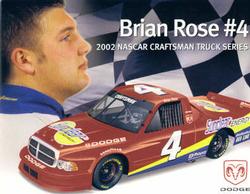
World Truck Series (NCWTS) driving the No. 4 SunClear Energy Dodge
Ram for Bobby Hamilton Racing (BHR). After qualifying a stout third,
Rose led several laps and found himself in contention for his first
career NASCAR victory. However, with less than 10 laps remaining,
Rose found himself shuffled out of contention and had to settle for
fourth.
 Switching
from trucks to cars and reuniting with his former crew chief
Danny Rollins,
the duo will look to pull off an upset Saturday afternoon when
Brian Rose Motorsports
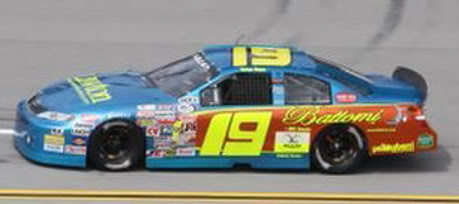
makes its ARCA Racing Series debut in the No. 19 Team ASE / Harris
Trucking Toyota Camry.
Switching
from trucks to cars and reuniting with his former crew chief
Danny Rollins,
the duo will look to pull off an upset Saturday afternoon when
Brian Rose Motorsports
makes its ARCA Racing Series debut in the No. 19 Team ASE / Harris
Trucking Toyota Camry.
The team participated in the open ARCA test at �The World Center of
Racing� last month and it was apparent that the sidekicks had not
lost any of their momentum. After playing conservatively early, the
team turned up the wick and immediately bolted one of the fastest
laps of the week.
Deciding to play it safe, the team elected to load up their hauler
and trek back home and make the final touches on their Japanese
nameplate while also scooping out the perfect race strategy.
�I�m excited about this weekend,� said Rose, who holds 41 NASCAR
Camping World Truck Series starts to his credit. �This is my first
go-around in ARCA, but I really feel like we�re going to have a shot
at winning the race on Saturday. Danny (Rollins) and the boys have
done an incredible job with this Toyota and I�m looking forward to
see how she performs under race conditions.�
What some might not know is that Rose was curious about what to
expect when he climbed in his Team ASE / Harris Trucking Toyota
Camry during the test. The NASCAR Camping World Truck Series did not
require restrictor plates while the stock-cars of the ARCA Racing
Series do which immediately demands a different driving style. It
took Rose about two laps to be accustomed to the new challenge, but
quickly that became something of the past.
�It was a little different at first,� said Rose referring to the
restrictor plate, which is designed to decrease the speed of the
cars. �Danny (Rollins, crew chief) was quick to get on the radio and
let me know what I was doing wrong. Quickly, I figured it out.�
 When
asked about his fondest memory of Daytona, Rose quietly replied,
�You can never forget the voice of Bobby Hamilton Sr.,� he said.
�You knew he meant business and he was a racer. He told me what to
do and I knew I had to do it. He was right because doing exactly
what he told me to do delivered a strong finish at Daytona.� Rose
drove for Hamilton Sr. in 2002 before the NASCAR icon passed away in
2005 after a stint with neck cancer. The Brian Rose Motorsports team
will race in his honor Saturday.
When
asked about his fondest memory of Daytona, Rose quietly replied,
�You can never forget the voice of Bobby Hamilton Sr.,� he said.
�You knew he meant business and he was a racer. He told me what to
do and I knew I had to do it. He was right because doing exactly
what he told me to do delivered a strong finish at Daytona.� Rose
drove for Hamilton Sr. in 2002 before the NASCAR icon passed away in
2005 after a stint with neck cancer. The Brian Rose Motorsports team
will race in his honor Saturday.
The ARCA season kicks off a busy season for the newly formed Brian
Rose Motorsports. In conjunction with the ARCA Racing Series
presented by Menards, BRM will participate in select NASCAR Camping
World Truck Series (NCWTS), NASCAR Nationwide Series (NNS) and Late
Model events all in hopes of a full-time touring schedule in 2012.
�In my books, the ARCA Racing Series opens the door to the new
racing season. I�ve watched the series grow tremendously over the
last couple of years and I expect nothing but a very intense and
competitive race. The fans will be standing till the end,
guaranteed.�
Lawton Insurance, Battomi and West Coast Autosource join Team ASE
and Harris Trucking as associate marketing partners on the
No. 19 Brian Rose Motorsports Toyota Camry.
Rose�s Life Back
On Track
Larry Woody |
Senior Writer, RacinToday.com 4/9/2025
 Brian
Rose is back in racing after being suspended from NASCAR
seven years ago for substance abuse. More importantly than
regaining his racing career, the young Bowling Green, Ky.,
driver has his life back. Brian
Rose is back in racing after being suspended from NASCAR
seven years ago for substance abuse. More importantly than
regaining his racing career, the young Bowling Green, Ky.,
driver has his life back.
Rose was scheduled to make his racing
return at Nashville Superspeedway but failed to make the
truck race lineup. He plans to try again May 2 at Kansas.
Rose and I just missed each other at the track. I was
running late, and when I went for him in the garage he�d
just departed. He told Terrell Davis, host of a local racing
radio show, that he hoped to see me somewhere down the
trail. I covered Rose during his racing days at old
Fairgrounds Speedway and was fond of him. He was bright and
personable and showed flashes of serious talent. I thought
he had the potential to follow a long procession of
Fairgrounds racers up the NASCAR ladder, drivers like
Darrell Waltrip, Sterling Marlin and Bobby Hamilton.
Then came the news: Brian Rose had been
arrested in a drug-related incident.
I was stunned, but then I�m always
stunned some a kid does something as stupid as messing with
drugs and ruining his life. NASCAR, as is its policy,
suspended Rose indefinitely. Not long after that I had a
chance to talk to him and ask him what happened.
He said his world had caved in on him �
problems at home, aggravations, irritations, all the thorny
problems that come with life. Most folks deal with them;
some escape to drugs. Rose began experimenting with drugs
and before he knew it � and would admit it � he had a
problem. He said getting busted was the best thing that
could have happened to him. It woke him up. When we talked
that day, several years ago, I asked what his future plans
were, and if he had any desire to return to racing. He said
he didn�t know, that he was taking it day-by-day. His first
goal was to stay clean. He�d deal with everything else
later.
He sounded sincere. I wished him all the best, and told him
to keep in touch.
At times over the ensuing years when I�d
hear about some driver getting busted for drugs, I�d wonder
what ever became of Brian Rose, and how he was doing. I
hoped he was OK. According to Davis, he is. Terrell said
Rose is in good spirits and seems to be the same bright,
outgoing youngster we used to know. He said he has his life
in order.
He appreciates the second chance NASCAR
has given him and is determined to take advantage of it.
That�s great news in more ways than one. It�s great to hear
that a good kid learned a lesson from a bad experience and
his life has been salvaged. It�s also an inspiring story for
anyone else out there � driver or otherwise � who�s batting
some sort of addiction: if there�s enough will-power there�s
always hope.
Maybe Brian Rose will go on to become a
great racer and collect lots of wins. But if not, that�s OK.
No matter how he does on the racetrack he�s already won the
biggest victory of his life.
� Larry Woody can be reached at
[email protected]
|
MORE TO THE STORY....
This story deserves attention and belongs to a driver whom most of us
had long ago forgotten about and whose career was left for dead several
years ago.
Brian Rose, a once-promising young race car
driver, will be behind the wheel of a NASCAR racing machine once again.
He was indefinitely suspended for violating the league's substance abuse
policy in the spring of 2003. He's back with Rick
Ware Racing, the same team he was driving for when he was banned
by the league. But he is not the same person we knew then.
 When
we last saw him, Rose was a broken, drug-addicted 23-year-old.
Sponsorship woes had limited his opportunities to race. In 2001-02, he
competed in 36 NASCAR Truck races, including stints with top-shelf team
owners Bobby Hamilton and
Billy Ballew, earning five top-10 finishes.
In 2003 he rejoined Ware, with whom he'd started his career, and raced
in two of the season's first four events, finishing 14th at Darlington
and 24th at Martinsville. The other two weekends he was stuck at home,
forced to watch others race on TV.
When
we last saw him, Rose was a broken, drug-addicted 23-year-old.
Sponsorship woes had limited his opportunities to race. In 2001-02, he
competed in 36 NASCAR Truck races, including stints with top-shelf team
owners Bobby Hamilton and
Billy Ballew, earning five top-10 finishes.
In 2003 he rejoined Ware, with whom he'd started his career, and raced
in two of the season's first four events, finishing 14th at Darlington
and 24th at Martinsville. The other two weekends he was stuck at home,
forced to watch others race on TV.
It was tough. There was peer pressure. He was young. He crumbled. "I
made a big mistake several years ago, and it really hit me hard," the
30-year old Bowling Green, Ky., native said this week.
Rose's story was not unlike that of NASCAR's other young, suspended
drivers during that brutal three-year stretch -- including Sammy
Potashnick, Shane Hmiel and Kevin Grubb -- who were all hit with
indefinite bans between 2002 and '04. They were young racers, all in the
Nationwide and Truck Series. They had some money in their pocket for the
first time in their lives and they were bored.
On April 26, 2003, two weeks after the Martinsville race, Rose was
informed by NASCAR that he had been suspended indefinitely for "actions
detrimental to stock car racing." Under the league's "reasonable
suspicion" policy, he was ordered to report to a medical office to be
tested. He never showed up, claiming that he'd gotten confused and went
to the wrong hospital across the street. He was immediately suspended
and filed an appeal, which was heard May 9 and rejected.
Five months later, while still claiming to be clean and innocent, Rose
was pulled over by police in his hometown for driving erratically. When
police approached the car he was gnawing on what he claimed to be
"chaw." They ordered him to spit it out. It was marijuana. Police
performed a search, during which they found more marijuana hidden in the
racer's pants and a handgun hidden in a Crown Royal bag.
Brian Rose went to jail. Then he simply vanished. "Instead of being
there at the racetrack, I was sitting at home, wondering why," he said
in a statement earlier this week. "I've been clean for a long time now,
but I've had to prepare myself physically and mentally to get back
behind the wheel. The time has finally come, and I'm ready to make the
best of it."
There is no doubt that many will watch Rose's return skeptically,
waiting for him to fall on his face. History says drivers rarely come
back all the way from where they've been. Hmiel was given second and
third chances and fumbled them both; he was finally banned for life in
2006. That same year, Grubb was banned for a second time when he, like
Rose, claimed to have gotten confused and didn't show up in the right
location to take his league-ordered test. Last May, Grubb committed
suicide.
Almost two years ago, another banned former TruckS eries driver,
Aaron Fike, confessed to me that he'd used
heroin on race days. That day I asked him about applying for
reinstatement to NASCAR. He admitted that the obstacle course set up by
the league was so difficult he was reluctant even to start the process.
"That is by design," NASCAR VP Jim Hunter
told me as I was working on the Fike story in March '08. "The road back
shouldn't be easy. Part of the process of reinstatement is proving to
NASCAR how badly you really want to be back in the sport. That means
rehabilitation, education, accountability, all of that. And it means a
lot of it before we are going to be willing to even consider allowing
someone to come back and get behind the wheel of a NASCAR race car."
That's exactly how it should be.
This same plan was laid out to Jeremy Mayfield
shortly after his now-infamous suspension in May '09. The process was so
daunting that the driver chose to go broke hiring teams of attorneys
rather than follow the reinstatement procedure.
"It is a discouraging process," added Dr. David
Black of Aegis Labs, the administrator of NASCAR's
substance-abuse testing procedure. Speaking specifically about the Fike
case, he said: "After a driver or team member learns of his suspension
from the league, he or she is put in touch with me and a contact within
NASCAR. We lay out the road map for reinstatement. It is a process that
even at a minimum is a very significant time commitment. It forces a
driver to prove how much returning really means. Typically there is an
initial phone call of explanation, and then we don't hear from them
again."
They did hear back from Brian Rose.
He met all of the requirements, checked every process off the list and
reported it all to the league offices. It took years. And in the middle
of his reinstatement journey, those processes became even more stringent
as NASCAR's substance-abuse policies were overhauled after the Fike
revelation. As Dr. Black put plainly: "If someone
survives the road back, then you cannot question their desire to return.
It's hard. It should be hard. And anyone who makes it back should
be applauded."


